
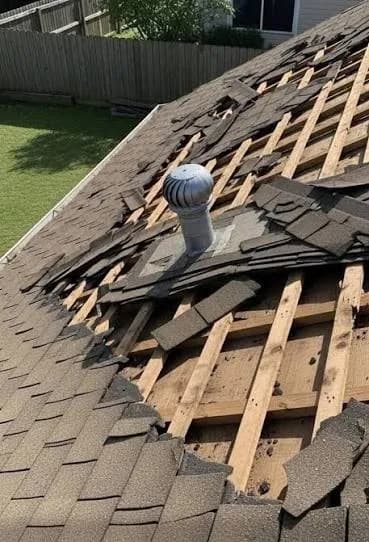
Why a leak costs more than it looks like it should
Water getting in through a roof can cause damage well beyond the outer covering. Finding a leak early limits the moisture and makes it easier to target the repairs that are actually needed.
Toiture AM can take you through inspecting your roof to find the source of the leak and determine what suits its condition — from a localised repair to a full replacement.
Understanding roof water infiltration
A leak appears when water gets past the elements that keep a roof watertight. It can then travel through the insulation or along the framing before becoming visible inside.
A visual inspection helps spot anomalies, but the source of the leak can be a long way from the stain you can see. A roofer therefore has to examine several vulnerable points rather than trusting the spot where the water shows up.
Common causes of leaks
The most common causes are a worn covering, damaged shingles, failed flashing and deteriorated seals. Other factors also come into play:
| Factor | Possible consequence |
|---|---|
| Weather and freeze-thaw cycles | Cracking in some materials |
| Blocked gutters | Overflow and water backing up under the drip edge |
| Standing water on a flat roof, or poor drainage during melt | Water getting in at the membrane's weak points |
The causes in detail
Our dedicated guide breaks down what actually causes a leak on Greater Montreal roofs, and why flashing tops the list.
Read: common causes of roof leaksThe signs of a roof leak
Rings on the ceiling, blistering paint, a persistent smell or damp insulation can all signal a leak. A leak does not always produce visible running water, though — the smell often precedes the stain by several weeks.
If you find one, start by protecting whatever is exposed, without climbing onto a wet roof, then get in touch so the suspect areas can be examined.
The full list of signs
Inside, attic, outside: every clue to look for, including the ones that show up before the first stain.
Read: how to detect a roof leakWhat the moisture does
When a leak persists, the moisture reduces the insulation's effectiveness, encourages mould and gradually degrades the framing timber. The damage then goes well past a ceiling stain and calls for more substantial repairs.
Looking for the cause with a professional is what determines how the roof gets repaired, and which measures will actually prevent the next leak.
An active leak right now?
The inspection is free and carries no obligation. The faster we get there, the more the secondary damage stays contained.
The roof inspection
An inspection looks for the main causes of a leak and assesses the damage before repairs are chosen. It covers the outer covering as much as the signs of moisture in the attic, where that is safely accessible.
After a storm or during snowmelt, this check helps catch something recent. We examine the vulnerable areas to establish whether a localised repair is enough or whether a replacement should be considered.
What you can safely check yourself
Start with a visual inspection from the ground — without climbing onto the roof or using a ladder to reach a suspect area:
- 1Outside, look for displaced shingles, clogged gutters and any part of the covering that looks like it is cracking.
- 2Inside, photograph the signs of moisture and note whether they appear during rain or during snowmelt.
- 3Note the exact location of each stain — even though the source is elsewhere, its position helps direct the search.
- 4Pass those observations to the roofer: they cut down the diagnosis time on site.
Need a hand with your own roofing project?
What gets checked during an inspection
The points to check include the seals, each piece of flashing around chimneys and openings, and the wear on the covering. The drainage and the junctions between surfaces also need examining.
| Location | What to look for, and what it means |
|---|---|
| Flat roof | Standing water can indicate inadequate drainage. |
| Attic | Damp insulation, stained wood or mould can reveal a leak, though none of them alone confirms where it originates. |
| Flashing and penetrations | Chimneys, vents and skylights account for most entry points. |
Why call a roofer
A professional can examine the roof with the right precautions and tell a leak apart from a condensation problem — two situations that look alike from inside but are not fixed the same way.
The roofer looks for the cause in order to determine how to repair the failed elements, rather than hiding their effects. We propose the repairs that match what was actually found, and say plainly if a replacement is warranted.
Repairing a roof leak
Repairs have to address the origin of the leak rather than just its visible traces. Depending on the inspection, the roofer may replace shingles, redo flashing or repair a failed membrane. Where the wear affects several areas, a replacement may be the better answer.
Working out how to repair it means identifying the path the water took. After inspecting, the damaged elements come off and the deck is checked before compatible materials go back on. Seals and any affected flashing are redone according to their condition. Simply applying a product on the surface is not always enough: soaked materials may need replacing too.
What to do immediately
Before a crew can get there:
- •Move furniture away and catch the water where it is safe to do so.
- •Keep clear of exposed electrical fixtures and stay away from a bulging ceiling.
- •Photograph the damage for your insurance file.
- •Do not climb onto a wet roof: finding the source requires safe conditions.
Your roof is leaking while it rains?
The full step-by-step during the downpour — including what to do if the ceiling forms a pocket of water.
Read: what to do when your roof leaksRoof types and their weak points
Roofs do not all share the same weak points when it comes to water. The slope, the covering, the junctions and the drainage all influence how a roof behaves during rain or snowmelt.
Water can get in through a punctured membrane, failed fasteners or damaged flashing. An inspection therefore has to account for how the roof was designed as much as how worn it is.
Flat roofs and their risk of leaks
On a flat roof, water standing for a long time can reveal a blocked drain or insufficient slope. Membrane junctions, drains and penetrations are the sensitive points to inspect, and temperature swings weaken some assemblies over time.
Coverings against the weather
Asphalt shingles, membranes and metal coverings offer different protection. How well they perform depends on the quality of the installation, the slope and the maintenance.
Over time some materials crack, lift or lose their protective layer. Choosing a covering therefore has to account for the climate, the deck and the roof's own requirements.
Ice dams
An ice dam forms when snow melts on a warmer part of the roof and refreezes near the colder eaves. The trapped water then backs up under the shingles and causes a leak — a particularly common cause between January and March in Quebec.
Preventing them means looking at air sealing, insulation and attic ventilation. Do not break the ice off yourself: you risk damaging the covering.
Preventing the next leak
To prevent leaks, have the covering, the junctions and the drainage checked regularly, particularly after significant weather. Gutters need to stay clear to limit overflow, and a visual check from the ground helps spot displaced shingles.
We can also check whether the attic insulation or ventilation is contributing to the moisture — that is often where the cause of a problem that returns every winter actually sits.